
Golden Previous Residents by Era
Begin with the source that matches the period you need. Golden has a strong current parcel and deed trail, but the historical household layer is split among repositories. The table keeps the date span and limitation visible.
| Source | Years it covers | Where held | What it shows |
|---|---|---|---|
| Recorder real-estate index | Live form: Permanent 01/01/1963-07/16/2026; Temporary 07/17/2026-08/18/2026; images from 01/01/1859 | Jefferson Aumentum and Recorder counter | Grantor, grantee, instrument, date, legal description, image lead |
| Assessor property history | Current portal; sample transfers include 1972, 2005, 2006, and 2015 | Jefferson Assessor | Parcel owner, value, transfer, and legal-property clues |
| Museum appraisal cards | 1949-2005 reported span | Golden History Museum | Building and property context; limited collection |
| Golden directories | 1871 verified; 1956 digitized; later run incomplete | FamilySearch, Google Books, museum, DPLA, DPL finding aid | Dated name, address, business, and local context |
| Sanborn maps | 1886, 1890, 1895, 1900, 1906, 1911, 1919 listed; 1890 verified | LOC, city, library | Building, street, lot, and use context; not a full resident list |
| Census and notices | Federal census through 1950; newspaper run varies | NARA, library, museum, historic newspapers | Household snapshots, obituary, marriage, civic, or business clues |
Use the table as a routing map. A previous residents search can use a 1956 directory to bridge two deed events, while a Sanborn sheet can explain a building footprint without naming a resident. An index date is not the same as an image date, and an appraisal card is not a complete occupancy record.
Golden Past Residents: Deed Chain
Start with the current Assessor card and copy the owner, PIN or AIN, legal description, subdivision, block, lot, and any transfer reception or document number. Search the Jefferson County Recorder as the current owner’s grantee. The matching instrument should identify the earlier grantor or seller. Search that earlier party as a grantee in the next step, while also checking both party roles for releases, liens, easements, deeds of trust, or correction instruments.
The backward loop is:
- Record the current parcel and legal description from the Assessor.
- Search the Recorder by owner name, grantor or grantee role, legal description, and date range.
- Match the instrument type, reception number, and recording date to the parcel lead.
- Open or order the image when possible, then carry the prior grantor into a new search.
- Pair each ownership interval with a directory, census, newspaper, permit, probate, or obituary clue before calling it a resident interval.
- Grantor and grantee
- The grantor transfers or releases an interest; the grantee receives an interest. A party role does not prove occupancy.
- Chain of title
- The linked sequence of recorded interests in a parcel, from a later holder toward earlier holders.
- Legal description
- The lot, block, subdivision, or metes-and-bounds identity used to bridge an address to the recorded land.
- Reception number
- The Recorder’s identifying number for a filed instrument, useful when a street search does not match.
The title chain is the spine of a previous residents search, but a title holder can be an LLC, trust, estate, or absentee owner. Keep the title role and household role in separate columns.
Golden Previous-Resident Index Dates
Jefferson County’s live Aumentum form and its public project notice use different coverage language. The current form inspected August 18, 2026 states a Permanent Index from January 1, 1963 to July 16, 2026, a Temporary Index from July 17 to August 18, 2026, and Images from January 1, 1859. A February 2025 county notice describes 600,000 newly searchable records and a 1970 expansion. The 2025 budget describes multi-year reimage, index, and redact work reaching back to 1859.
For previous residents, that difference is useful rather than confusing. A previous residents query may describe one index layer while the image statement describes another. Preserve the text shown by the live form, cite the project notice as a separate statement, and ask the Recorder which record series applies when the name or instrument is absent.
Search a legal description or reception number when a street address fails. Record the query date, selected party role, date range, and result status. A blank in one layer is a prompt to use the counter, phone, mail, or copy-order route, not a negative finding.
Insider tip. Use the PIN or AIN and reception number as the crosswalk. Street text can vary, but the parcel and recorded instrument identifiers give the Recorder a clearer starting point.
Golden Deed Parties Are Not Residents
A recorded deed traces an interest in land, not the full household. A transfer row may name an organization, trustee, estate, or buyer whose mailing address is elsewhere. A seller may have moved before the deed was filed. A current owner may never have occupied the parcel. The same caution applies to a permit applicant, a voter registrant, and a newspaper name.
To test a past resident, anchor a dated name to a street or parcel through at least one independent source. A directory can provide an address and occupation marker. A census can provide a household snapshot. A newspaper can report an obituary, marriage, business, or civic event. A permit can tie a project to an address but does not make the applicant a resident. A probate docket can supply an estate or heir lead while vital certificates remain eligibility-limited.
This role separation is the key to a reliable previous residents trail. The address is the constant; the person’s record role changes over time.
Golden Past Residents and Appraisal Cards
Golden History Museum’s property-research page reports appraisal-card coverage from 1949 through 2005, with limits. The cards can add building and property context to a deed interval, especially when a directory year is missing. The museum routes historic-district questions to City Planning and deeper county property research to Jefferson County Archives. Museum maps, directories, newspapers, oral histories, and civic files may fill a gap that a parcel card cannot.
The museum’s holdings are not a full address roll. Ask for an exact property, year range, historic district, parcel clue, or accession lead. State whether the goal is a building history, an owner interval, an occupant clue, or a dated family connection. That description helps staff choose a card, map, newspaper, or archive series.
The Golden History Museum property-research page below illustrates the proper role of the collection in a Golden past-residents search.

A museum property clue is strongest when it is paired with the Recorder’s legal description and a dated name source.
Golden Sanborn Sheets for Past Residents
Sanborn maps give a previous residents search a building and street frame. Golden city metadata lists sheets from 1886, 1890, 1895, 1900, 1906, 1911, and 1919. The Library of Congress verifies a Golden, Jefferson County, November 1890 item with six sheets. The maps can show footprint, use, construction material, street names, and lot context, but they do not identify every person who lived in a structure.
Match the sheet to a legal lot, cross street, subdivision, or building shape. Then compare the map with the 1871 Golden City directory section, the 1956 digitized directory, newspaper notices, and census boundaries. This is also a way to test an old address when modern street text has changed.
No authoritative Golden street-renumbering year was located in the research. Do not create one. Use Sanborn, directory cross streets, historical community names, legal descriptions, and current GIS as a documented bridge between eras.
Golden Past Households Across Directories and Census
The verified 1871 Rocky Mountain Directory and Colorado Gazetteer places a Golden City section in the 319 to 332 area and shows a name, occupation, residence marker, street, and nearby-street style. The 1956 Golden Colorado City Directory is a separate digitized local item. The complete publisher and year sequence after 1871 remains unresolved, so a missing volume should be marked as a research gap rather than filled with an assumed commercial series.
Pair each directory year with the nearest federal census year, while remembering that enumeration boundaries and street labels can differ. Search the household name, address, business, nearby cross street, and historic community name. A person who disappears may have moved, died, changed a surname, gone unlisted, or fallen outside the volume’s coverage. Newspapers, cemetery results, probate, and the next directory year can help distinguish those possibilities.
The 1956 Golden directory item below is a concrete local directory source, even though the text session did not expose a stable complete entry line.
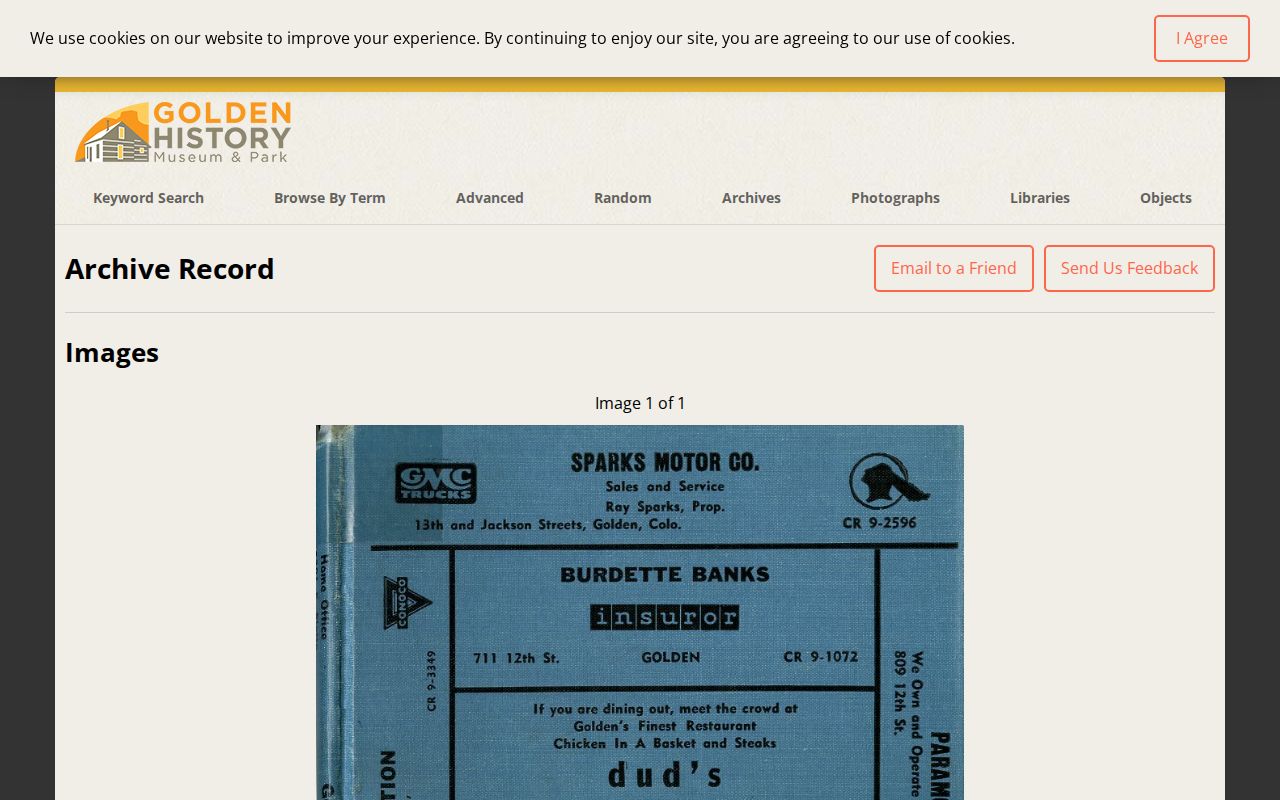
Transcribe only what the scan supports. The Golden city directories page explains the verified runs, reading method, and repository questions without turning the 1956 metadata into an invented household example. Previous residents should remain tied to the scan year.
Golden Historic Names of Past Residents
Modern postal and municipal labels can conceal the community name used by an older record. Golden History Museum’s collection scope names Mount Vernon, Apex, Lookout Mountain, Golden Gate Canyon or City, Crawford Gulch, Arapahoe City, Fairmount, Wide Acres, Genesee, Pleasant View, Leyden, and Applewood. Some are now associated with other municipalities. An old directory or newspaper may therefore index a place under a name that a current Golden search never returns.
For an address that seems to vanish, keep the modern PIN or AIN and legal description fixed while varying the historical search words. Test the old community name, cross street, subdivision, lot or block, map sheet, and “Golden City” wording. Compare the result with current city-limit and ZIP layers. This avoids guessing at a renumbering event and preserves the evidence for each change.
Close a Golden Past-Resident Trail
Obituaries and probate can close an address interval. Search Colorado Historic Newspapers, library databases, museum material, and the Denver Public Library obituary finding aid for a name, date, street, relative, organization, or business. Verify OCR against the page image. The DPL index covers Denver Post and Rocky Mountain News notices from 1913 through 2016, with later access through a library-card database, so locality must be checked rather than assumed.
For an estate lead, identify the likely county and date, then request public probate material through Jefferson Combined Court. A probate docket or notice can name heirs, an estate representative, an address, or a date of death. A death certificate remains restricted unless the requester qualifies. The Golden Cemetery map supplies a local burial search, but its source coverage date is not stated.
Use the Golden by-street address route when the historical trail needs a current parcel or deed anchor. Keep the source date, record role, URL, and confidence beside each name. Previous residents should be presented as dated, sourced clues, not as an unqualified roster.
Lawful house history. Past-resident research can support family history, preservation, and estate work. Stop at protected records and never use an address trail to stalk, harass, intimidate, or harm anyone.